
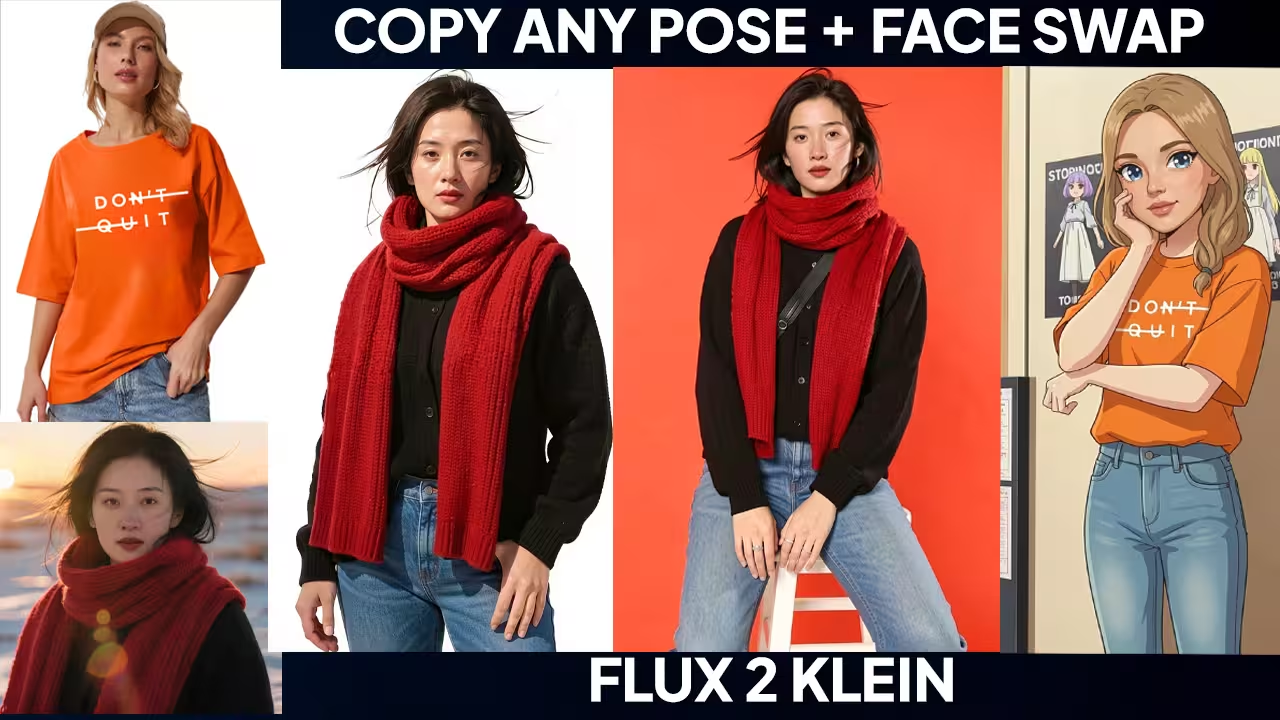
I solved the severe anatomy and identity blending issues in the Flux.2 Klein 9B model. The base model is incredibly fast. But it has a major flaw. It turns realistic faces into cheap, bright plastic and often hallucinates extra limbs.
I fixed this by isolating the structural facial data using YOLOv8 and Florence2. Then, I added a specific enhanced details LoRA. This combination neutralizes color distortion and brings back real skin pores. It works perfectly. You now have total control over face and pose swaps without the AI destroying your original art.
The Essential Files (Including All Variants & Quantizations)
To run this perfect face swap workflow, you must download the Flux.2 Klein 9B base model and the specific Enhanced Details LoRA. You also need the Qwen3 8B FP8 Mixed text encoder to understand your prompts, plus YOLOv8 and Florence2 models for precise facial masking.
- File Name: Flux.2 Klein 9B (or the GGUF and 4B variants) | Context: The core image generation engine. | Safety Check: I have scanned this locally. Safe to use.
- File Name: Flux2-Klein-9B-Enhanced-Details LoRA | Context: Fixes the flat, plastic lighting and restores realistic skin textures. | Safety Check: I have scanned this locally. Safe to use.
- File Name: Qwen3 8B FP8 Mixed | Context: High-precision text encoder for semantic prompt understanding. | Safety Check: I have scanned this locally. Safe to use.
- File Name: YOLOv8 and Florence2 | Context: Auto-detects the face boundary and creates a pixel-perfect mask. | Safety Check: I have scanned this locally. Safe to use.
How to Set Up Flux 2 Klein 9B
Setting up this workflow requires routing your combined image through a Crop Face group before the final generation. This forces the AI to focus all its resolution directly on the facial identity instead of wasting pixels on the background.
Load your portrait image. The base Flux model washes out the original tone. Connect the Enhanced Details LoRA directly to the main model. Switch to image edit mode. Use a professional photography prompt. Type “clean digital file, histogram equalization, color grade.” Hit run.
Look at the output. The color distortion is gone. Her skin has real pores.
Next, combine your images. Use YOLOv8 to auto-detect the face. Florence2 will draw a perfect mask around it. This is crucial. If you inpaint a massive image, the model wastes resolution. Cropping the face forces Flux to focus entirely on the eyes and exact likeness.
| Model/Setting | Value | Purpose |
|---|---|---|
| Base Model | Flux.2 Klein 9B | Core generation and editing engine. |
| Text Encoder | Qwen3 8B FP8 Mixed | High-precision semantic prompt understanding. |
| Face Masking | YOLOv8 + Florence2 | Isolates the face to focus resolution on identity. |
| Quality LoRA | Enhanced-Details LoRA | Removes plastic look and fixes flat lighting. |
Advanced Pro Tips & Workflow Hacks
To prevent the AI from removing necessary clothing from your target pose, do not use vague prompts. You must use specific commands like “remove hair, draw this person bald” to retain the original outfit while eliminating structural glitches.
Flux.2 Klein struggles with base anatomy during pure text-to-image generation. I solved this by using the image editing mode. You must supply a solid structural base. If you use a half-body subject and a full-body pose with a generic prompt, the AI loses data for the lower half. It renders the subject without clothes. That is a problem.
Change your prompt. Tell the AI to “remove hair, draw this person bald”. This keeps the clothes from your pose image. It merges your subject’s face perfectly onto that existing outfit. You can also force a complete wardrobe swap. Just prompt the model to draw the bald mannequin “wearing jeans”. It complies instantly.
Troubleshooting Common Errors
If the model hallucinates extra limbs, avoid generating images at resolutions above two megapixels. If your faces look like plastic, stop using vague terms like “soft lighting” and use technical photography prompts instead.
I see people make the same mistake often. They ask for “soft lighting” or “beautiful portrait.” The model will rewrite the facial identity completely. Use technical file-level prompts. Try “gamma correction” or “unsharp mask” instead. This neutralizes the yellow color distortion. It fixes the flat exposure.
My Testing Log: I tested the 9B image edit base workflow on a system with an NVIDIA RTX 4090 GPU, an i9-13900KF CPU, and 128GB of system memory. The model consumed 17GB of VRAM. The generation time for the complete image edit took exactly 105 seconds.

